Thursday, February 28, 2008

Forget spring, it feels downright summery today!


The house finches are paired up, singing their little red rumps off, and enjoying some seed. No nest building yet, however.


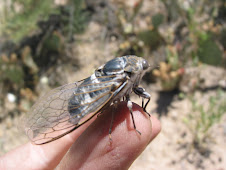
I caught my first cucumber beetle of the year as Andie soaked up some sun in the cloverfield.


A new elementary school is being built in one half of the field. We are trying to enjoy the remaining space as much as possible before it is replaced by a Best Buy or other Huge Store.


Mount Hood even made a rare winter appearance. It did not show up well in this photo, but it's there. Hood is Oregon’s highest peak and our closest big volcano (that I’m aware of). On a clear, non-hazy day, I need only walk about two blocks for a view of the tip of the mountain. Better views can be found to the southeast in Beaverton and Aloha where the base of Hood is not obscured by the Tualatin Mountains.


To get to my nearest viewpoint of Mount Saint Helens, I must drive a few miles to the west to the Burgerville parking lot. This rumbling alabaster beast can be better viewed from Portland, but this glimpse requires less fuel.

Mount Jefferson, Oregon’s second-highest peak, lies to the south and the only nearby views I have found lie along several stretches of highway 26 in the eastbound lane, so I don’t get many chances for photos of this one.

Tuesday, February 26, 2008

Nest Season, Gull Season

As you may have gleaned from previous posts, bird nest study is my professional specialty and a serious hobby. Strange as it may seem, bird reproduction occupies much of the space between my ears, especially during the spring and summer months when I am always on the lookout for new nests to observe.


I keep a nest journal for my own reference and I enter data from the journal into spreadsheets to back up the information.


When I am observing nests and I do not have a research permit, I act as noninvasive as possible by refraining from handling eggs or nestlings, and I do not intentionally flush incubating adults. After five years of working on nesting studies where detailed information was valued at any price, it was hard to break the above habits, but I’m trying to set a good example for amateur naturalists.
For me, every nest is an opportunity for to learn more about its builders. A found nest is also an opportunity to collect data that could be of future use to others. Timing of nesting behaviors is probably the most valuable data I can collect. I expect climate change will have a big impact on reproductive timing and I hope to help document the magnitude of these effects. I am also interested in nest survival estimation methods. Most established techniques require handling eggs and flushing adults to obtain a good estimate of nest survival. In the coming years, I plan to look for a lot of American robin and bushtit nests to develop less-invasive techniques.

During the winter months when I am not busy with nests, gulls occupy the void left in my brain. At least ten species of gulls can be spotted in western Oregon in winter and it has been quite a challenge to identify them all. Gull watching requires much patience and research and I consider it a completely separate hobby from birding. Learning the molts, hybridization, delayed plumage maturation, and feather fading patterns of these birds can cause headaches for many, but it keeps me busy during the dark and rainy winter hours.


I also keep a gull journal, in which I document my sightings which I hope to someday use to identify patterns in occurrence and abundance of our winter visitors.

I had not had the opportunity to collect gull data from inside our apartment since our window does not face typical gull haunts such as lakes, parking lots, or city parks. Yesterday, however, I watched a pair of gulls perch on the roof of the building outside my window. I couldn’t get a photo with our dinky camera, so you will have to take my word that one was an adult western gull and the other a first-winter western gull. This species does not stray from coast as frequently as their glaucous-winged cousins, so they are always a welcome sighting. Most of the birds I see near the apartment are glaucous-winged gulls, glaucous-winged hybrids, or ring-billed gulls. If I wander farther to some large parks, I may find California gulls and the smaller mew gulls, my wife’s favorite.

Monday, February 25, 2008

Deck Garden Maintenance

This weekend, I performed some overdue maintenance on my deck garden/bird feeding station. We live on the third floor and face the northwest, so the deck does not receive much sun or rain at any time of the year. I therefore try to grow forest understory plants and herbs and veggies that I found, through trial and error, can survive on the deck.


My containers were in disarray, filled with remnants from the last growing season and weeds that took hold. The surviving plants needed pruning and watering to improve their appearance and help them make it to the next summer. So far, the only native survivors are my beloved Indian plum, a vine maple, and two bunches of purple wood sorrel. Among the herbs, a purple sage, an English lavender, an Italian parsley, and some dormant Hood strawberries remain.


The indian plum now has four inflorescences emerging from their buds.


I cut down the remnants of last year’s cherry tomatoes, the only types that grow well under our poor sunlight conditions. I leave the twine loosely attached to the frames for the house finches to use as nest material.


I sprinkle seed into the large pots for ground foraging birds such as mourning doves and juncos.


The finished product! Ready for this spring’s planting...

Saturday, February 23, 2008

Dawson Creek Field Trip

Yesterday, Sarah, Andie, and I returned from our winter vacation at the coast. Details of that trip can be found at our DogBlog.
Today, I woke early and headed out to Dawson Creek Corporate Park in Hillsboro to lead an Audubon Society of Portland field trip.

This was the first trip offered at this park, so I was not sure if many would show. I was pleasantly surprised to find at least 17 participants eager to bird a new area. Some folks were expert birders, most were new to the hobby, and a few had never been on a birding trip.

We started by identifying many species of waterfowl in the ponds by the new Hillsboro Library. We viewed a pair of great blue herons roosting in a short tree near their usual nest site. I hoped we would see them building this year’s nest, but they have not yet begun construction. We moved on to a small woodland and picked up a few songbird species, then listened to many birds that seemed inspired to sing by the great sunny weather.
We moved to a bluff above a riparian zone loaded with snags housing several granaries tended by a colony of acorn woodpeckers. After a few minutes, several woodpeckers flew overhead carrying acorns to the snags. We watched them chose a hole, insert their acorn, then inspect their work to make sure the acorn was snug, lest they get stolen by hungry scrub jays. The presence of such an active colony was a big surprise to all on the trip

Last week, I had spotted an owl nesting in a snag a few dozen meters from the granaries, so I checked the snag again and did not see the bird at first. I kept looking and eventually saw a dark area in the center of the broken trunk. I spotted some barring in the area and realized the dark spot was the owl. After a lot of direction-giving, persuasion, and squinting into spotting scopes, we were all able to see the owl.
We continued around a few more ponds and found even more species of waterfowl. We watched an Anna’s hummingbird drink sap from wells excavated by red-breasted sapsuckers and later found the sapsuckers themselves.

We finally returned to the library after three hours of birding. Participants said that they had a great time and the park far exceeded their expectations. Not bad for man-made habitat. The area and the birds did not disappoint, so I look forward to leading more trips here.

Birds seen:
Great blue heron
Canada goose
Mallard
Gadwall
American wigeon
Northern shoveler
Green-winged teal
Wood duck
Lesser Scaup
Ring-necked duck
Bufflehead
Common merganser
Red-tailed hawk
Killdeer
Glaucous-winged gull
Great-horned owl
Anna’s Hummingbird
Belted kingfisher
Northern flicker
Acorn woodpecker
Red-breasted sapsucker
Western scrub jay
Common raven
Black-capped chickadee
Brown creeper
Ruby-crowned kinglet
American robin
European starling
Yellow-rumped warbler
Spotted towhee
Song sparrow
Fox sparrow
Dark-eyed junco
Red-winged blackbird
Brewer’s blackbird
American goldfinch

Saturday, February 16, 2008

First nests of '08!

Sarah, Andie, and I took a walk at Dawson Creek park today and found some great birds, including the first nesting behavior I’ve seen all year. As I’ve mentioned before, I am a huge nest junkie and I’ve looked forward to the spring nesting season since last September when the last of the barn swallow nestling fledged. The first nester was a great blue heron staking out it’s nest site in a tall Doug fir next to the New Hillsboro Library. At least one pair of herons nested in this tree during the previous two years that I’ve lived in Oregon. The old nests have fallen out of the tree, so I expect the adults will start bringing branches to the site soon.

The second nest was a very serendipitous find. Sarah spotted a pair of common ravens,(which we have never seen here before!) and I noticed that they were harassing a raptor-like bird. When we were closer to their spot, I realized the raptor was a great-horned owl perched on a branch of a snag. Below this owl, another was wedged into the top of a trunk, sitting on a nest.

I will be leading a Portland Audubon field trip at the park next Saturday and it will be nice to show the participants this nesting activity.

I hope to post photos of these nests at later dates.

Friday, February 15, 2008

Cloverfield Walk

Once or twice a week, Andie the Dog and I take a walk through a large field of clover south of our apartment. The south end of the field has a small drainage pond and the condo complex across the street surrounds a small patch of forest that is usually filled with birds. Today’s walk was especially productive, here are some highlights.


A flock of 100+ American robins were picking through the field. At least two males performed the first robin songs I’ve heard all year. Robins are one of my favorite local birds because they build many easily observable nests in the spring and I am a huge nest junkie.


The pond contained the usual male bufflehead, three pairs of gadwalls, and a pair of American wigeons.


In the forest patch, I noticed that beaked hazels are opening their bright green and yellow catkins.


The pendulate flowers are the male parts and the buds with bright red filaments are the female parts. I am not sure about the adaptive significance of such bright color on parts that are used to collect wind-dispersed pollen. I hope a botanist reads this and chimes in.


Last fall, I collected a bagful of nuts from these hazels. I brought them home, peeled of the slivery husks, cracked the shells, removed the meat, toasted them in a fry pan, and added them to a pesto. It was probably the most labor-intensive vegetarian pasta dish in recent history.

Wednesday, February 13, 2008

Indian Plum Wakening


One of the perks of western Oregon’s mild winters is the fact that many deciduous plants reawaken early in the year. One of my favorite deciduous shrubs is Indian plum, a west coast member of the rose family. Sarah and I have a three-foot tall sapling potted on our deck and its buds are beginning to open.


We purchased the plant last year from Portland Audubon’s Native Plant Sale when it was leafed-out but not flowering. Indian plum is a dioecious species, meaning individuals are male or female, never both. I am quite interested in these types of plants, because I have been researching cottonwoods, which are also dioecious, for several years.
This morning, I noticed a tiny inflorescence (left) and a set of leaves (right) emerging from the largest bud on our little Indian plum.


Since this will be the first set of flowers it produces, I do not know if they will be male or female and I feel like an expectant parent in the pre-ultrasound era! I am hoping it’s a girl, so I can try my hand at raising new saplings from the seeds, if the birds don't beat me to them.


Last year, I sketched the male and female flowers and recorded the gender of every flowering Indian plum I found to determine sex ratios in different locations. Of 162 flowering individuals, 125 were male and only 37 were female. I guess that means mine is most likely a male, too.