Showing posts with label beach. Show all posts

Sunday, August 17, 2008

Cool Weather and Cooler Birds


This weekend, we escaped the triple digit heat of the Willamette Valley by driving to the coast.


The temperatures were magically 30 to 40 degrees cooler and there were even a few thunderstorms over Tillamook Bay.

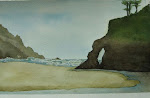
As usual, these rocks were covered by pelagic cormorants, brown pelicans, and pigeon guillemots.

We spent several nights in Pacific City and we conducted our monthly dead bird surveys at our two beaches.


On Sunday, we surveyed the beach at Sand Lake. The morning was really foggy and cool, and once we hit the beach we could see a fairly large bird standing upright near the mouth of Sand Lake.


As we walked closer, we realized it was a juvenile peregrine falcon plucking another bird. We left the falcon to its plucking and completed the rest of the survey.


When we returned to the kill site, the falcon flew across the lake and waited while we quickly processed the bird.


It turned out that the falcon had captured a male northern pintail in transitional plumage.


The falcon had spent about an hour plucking the prey and had just started to consume it when we scared it off. After measuring and photographing the pintail, we walked away as fast as we could so the peregrine could resume its breakfast. Our survey finished, we returned to Pacific City to get our own breakfast at the Grateful Bread, our favorite restaurant in town.

Monday, July 7, 2008

Beach Finds

As usual, we spent Independence Day weekend in Pacific City. The weather was cold, gray, and wet, a nice break from the heat and humidity of Hillsboro.


On Friday, we brought Andie to the tidepools of Cape Kiawanda. She had a great time jumping on rocks and seeking interesting smells.


While Sarah likes to find rare creatures such as chitons and nudibranchs hidden among the more common residents, I am most interested in two of the main players in the tidepool saga: seastars (Pisaster ochraceus) and California mussels (Mytilus californianus). These species seem to be locked in a never-ending battle for survival. The seastars are always looking to have mussels for their next meal, and the mussels seek spots on the rocks that become too dry at low tide for the seastars to survive.


We found a seastar that had just finished one mussel and was holding on to another for its next course. The first mussel had been opened by the star's tube feet, its contents digested by the external stomach of the predator. Life seems tough for mussels, but they are capable of moving along the rocks to find places that are safe from seastars.

We also surveyed our beaches for dead seabirds.


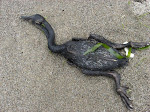
At Bob Straub State Park, we found our second black-footed albatross of our dead bird counting career. It was a molting adult that was fairly intact. We tried to get Andie to pose near it for a size comparison, but she was not interested.


Along the survey routes, we also found a large number of pelagic goose barnacles (Lepas anatifera) stuck to washed-up items such as kelp, driftwood, and bird feathers.


Pelagic barnacles are fascinating creatures that live their lives at sea attached to floating debris until they drift ashore and die. I have seen some that are quite large, about eight inches long, but they can reproduce at small sizes to which they must grow quickly because their time at sea may be limited.


I imagine that forensic scientists would be interested in their growth rates to determine how long certain things had been out to sea.


I had never seen so many attached to so many things before this weekend. I am not sure if the bumper crop we observed is due to currents keeping all this debris at sea long enough to collect many barnacles before washing up or if their are unusually high numbers of barnacle larva out there seeking attachment sites.