With numerous commitments piling up, Sarah and I decided to end our monthly surveys of dead birds at the beach north of Sand Lake. We will continue surveying the beach at Bob Straub, however, which will ensure us at least twelve trips to the coast per year.
 The mouth of Sand Lake forms a nice broad beach that is lightly visited by humans for much of the year, perfect for excercising the dog.
We have found many interesting dead and live birds in this area, so we will return as often as possible.Now that our Sand Lake surveys are finished, I have organized data from the sites and found some interesting trends.
We conducted 40 surveys on the beach between May 2006 and August 2009.

Number of birds found per mile varied from zero to 18, with August and September being the busiest months.

We found 29 species of birds on the beach, but the birds we encountered most often were Common Murres and Northern Fulmars, two species that differ in their seasonal patterns.
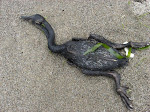
 We found most Common Murres, like the juvenile below, in late summer during the end of the breeding season.
Unlike murres, Northern Fulmars do not breed on the Oregon coast. Instead, they nest off of Alaska and Canada.
 We found the most fulmars during fall, late winter, and spring.
We encountered several interesting species such as a Pacific Slope Flycatcher, a Short-eared Owl, and the Black Oystercatcher above. Though would rather see live than dead birds, we appreciate the opportunity to closely examine species that we would not otherwise see.